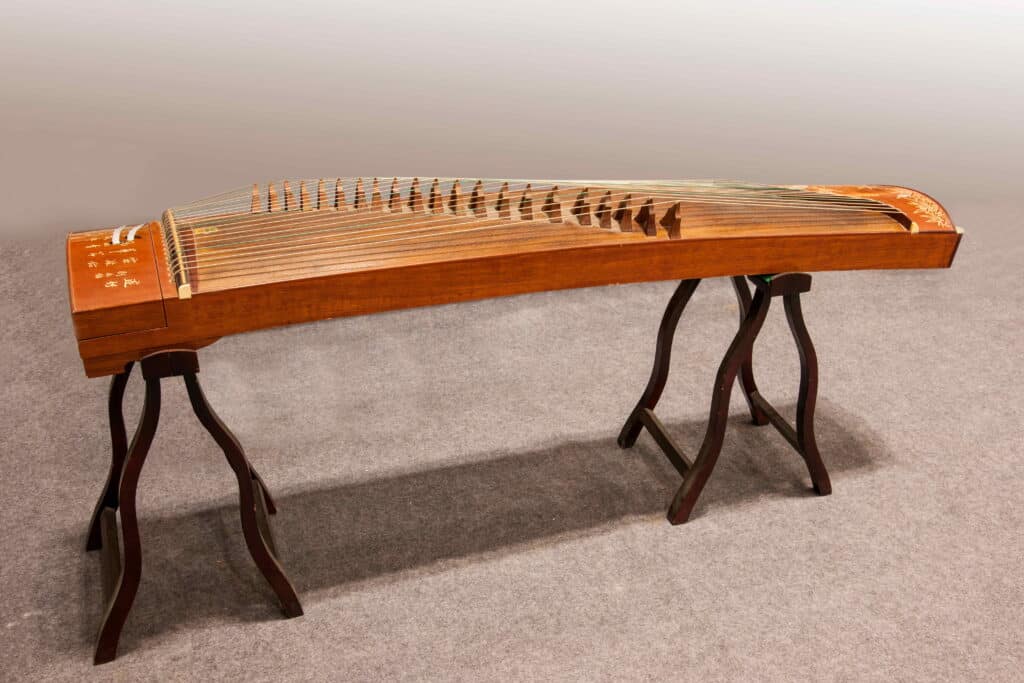

Guqin history is rooted in thousands of years of cultural evolution, intellectual expression, and artistic refinement. From its earliest engraved ideograms to the refined seven-string form cherished by scholars, the guqin has been revered as a symbol of philosophy, self-cultivation, and communication with nature. Understanding this instrument is not only about appreciating music, but also about experiencing a living timeline of Chinese civilization.
Across dynastic eras, guqin history shaped poetry, rituals, meditation practices, and personal identity. Its sound was believed to harmonize the human spirit with the cosmos. Every change in structure, playing style, and symbolism reveals how the Chinese worldview transformed over centuries. Today, the guqin stands as both a heritage treasure and a path to mindfulness, allowing people to reconnect with ancient wisdom in a rapidly moving world.
1 – Origins Before Recorded Dynasties
Guqin history begins with mythological references linking the instrument to legendary sage rulers such as Fuxi and Shennong. Early archaeological discoveries include fragments of stringed wooden instruments in Neolithic sites, suggesting that proto-qin forms existed before organized states emerged. Though the guqin’s earliest shape cannot be precisely reconstructed, its concept as a contemplative ritual tool likely predates written language.
Over time, as bronze technology and agricultural society flourished, rituals governed by harmony and cosmology established the guqin’s role as a bridge between humans and heaven. Whether or not the mythical inventors truly existed, the stories reflect the timeless belief that music shapes morality and universal order.
2 – Zhou Dynasty Ritual Importance
During the Western Zhou era, guqin history evolved within the court’s ceremonial framework, where music represented social hierarchy and harmony. The guqin was used to accompany poetry recitation and moral instruction among nobles, reinforcing Confucian ideals that music cultivates virtue. The “Yayue” system defined pitch relationships and assigned symbolic meanings to sounds, seasons, and directions.
The instrument’s expanding symbolic function created a cultural expectation: the noble and educated were responsible for mastering self-discipline through music. Its value was therefore not entertainment, but ethical refinement and civic responsibility.
3 – Qin and Han Dynasty Symbolic Authority
As guqin history entered the Qin and Han dynasties, the instrument became tightly associated with philosophers, statesmen, and scholars. Han scholars developed modal systems and standardized form, including lacquered wood structures and silk strings. Literature from this era romanticized solitary playing under moonlight, emphasizing serenity and emotional restraint.
Political centralization also shaped symbolism. The guqin became an emblem of loyalty and integrity, especially among officials who retreated from public life to protest corruption. Playing the qin became both a personal refuge and a subtle political act.
4 – Three Kingdoms to Tang Dynasty Cultural Flourishing
Guqin history deepened during the Wei, Jin, and Tang periods, when Daoist and Buddhist influences encouraged introspection and naturalism. Qin masters such as Ji Kang celebrated personal expression, rejecting rigid authority and embracing musical spontaneity. Famous qin societies formed among poets and artists who pursued harmony with nature.
By the Tang dynasty, musical craftsmanship reached a technical height. Complex tuning systems, innovative playing techniques, and treatises refined the instrument into a scholarly art form admired throughout East Asia. The guqin became a passport into elite intellectual circles, linking individuals across vast distances through shared ideals.
5 – Song Dynasty Documentation and Notation
Guqin history advanced dramatically in the Song dynasty with the development of standardized tablature known as “jianzi pu.” This notation system allowed players to transmit techniques and entire compositions through generations without sound recording. Collections like “Qinshu Daquan” preserved ancient melodies and philosophical commentaries.
The Song period also established the guqin as the keystone of literati culture. Mastery of the instrument joined calligraphy, poetry, and painting as the four arts of the cultivated scholar. Performance moved away from court ceremony into private studios, reflecting a shift toward personal cultivation instead of public authority.
6 – Yuan and Ming Dynasty Expansion of Schools
During the Yuan and Ming eras, guqin history branched into distinct stylistic schools. Teachers passed down interpretive traditions shaped by regional aesthetics and differing views of musical emotion. Some favored serene, slow modes emphasizing spiritual purity; others explored bolder expressions that mirrored dramatic social changes.
Instrument makers developed recognizable body shapes and lacquer methods that influenced sustain, warmth, and resonance. As playing techniques diversified, the guqin became a canvas for individual personality, while preserving ancient philosophical roots.
7 – Qing Dynasty Preservation and Debate
Guqin history during the Qing dynasty was characterized by active preservation and scholarly debate. Experts compared ancient manuscripts, seeking to revive authentic tones they believed had been lost over centuries. Extensive cataloging of instruments, masters, and compositions attempted to build an archival bridge to early dynasties.
At the same time, music became increasingly structured and academic. The tension between innovation and tradition sparked discussions about how faithfully one must adhere to ancient interpretations, a question that continues to influence teaching styles today.
8 – Twentieth-Century Decline and Revival
Guqin history faced serious challenges during the twentieth century due to political turmoil, modernization, and shifting cultural values. Many teachers and instruments were lost, and traditional music was pushed aside to make way for Western influences and mass entertainment. The guqin, once a respected symbol of scholarly virtue, risked fading into obscurity.
Revival began through dedicated musicians who preserved lineage teachings, recorded surviving pieces, and introduced the instrument to global audiences. Efforts to protect cultural heritage amplified awareness, teaching new generations to listen with patience and spiritual depth rather than commercial expectations.
9 – Contemporary Renaissance and Global Connection
Today, guqin history continues to unfold as modern learners embrace the instrument around the world. Digital tablature archives, academic programs, and international performances allow audiences to explore its tranquil aesthetics. Many find comfort in the meditative, slow-paced qualities that counterbalance fast digital lifestyles.
Contemporary craftsmanship also flourishes, reviving traditional lacquer and wood selections while experimenting with new materials that expand accessibility. The guqin’s voice transcends boundaries: what began as a personal ritual of Chinese scholars now invites universal reflection and connection.
The Guqin in Literature and Philosophy
Poems, essays, and legends across history depict the guqin as a companion to contemplative thought. Writers imagined melodies floating over rivers or echoing in remote pavilions where thinkers sought clarity. Philosophers used music as a metaphor for human virtue, encouraging listeners to align desires with cosmic order. These stories ensured the instrument’s lasting emotional presence.
Even today, reading classical poems while listening to gentle guqin phrases evokes landscapes, moonlight, and quiet courage. Literature gives the instrument a spiritual role, reinforcing the idea that music can shape one’s moral direction.
Craftsmanship and Aesthetic Ideals
Instrument-making techniques passed down through generations demonstrate the value placed on harmony between function and philosophy. Each step — wood selection, shape carving, silk binding, lacquer layering — reinforces the belief that beauty comes from patience and natural balance. Subtle imperfections are celebrated as reflections of authenticity.
Modern luthiers honor this legacy by preserving core methods while seeking stability against climate changes. Whether antique or newly built, the guqin embodies craftsmanship that merges physical artistry with metaphysical intention.
Musical Language and Playing Techniques
The guqin’s vocabulary of plucks, harmonics, slides, and vibratos creates a deeply expressive language. Because many tones are soft and require careful attention to hear fully, performance is an invitation to slow down and notice subtle changes in breath, mood, and energy. Silence between notes is considered part of the music rather than a gap.
Players often describe the sensation of fingertips gliding across strings as a dialogue between self and nature. Techniques passed down through master-disciple relationships carry emotional memory, preserving not only sound but wisdom about how to live thoughtfully.
Cultural Survival and Identity
Efforts to sustain guqin education emphasize community, respect, and continuity with ancestors. Museums, music associations, and independent studios work to keep documentation accurate and vibrant, ensuring the instrument retains its authentic heart while adapting to modern contexts.
For many, learning the guqin is a personal journey toward inner stillness. By practicing skills nurtured for centuries, players feel connected to a heritage that values subtle insights over grand spectacle. Cultural identity is strengthened when traditions are lived rather than merely observed.
UNESCO Recognition and Education Expansion
In 2003, international recognition helped revive interest and safeguard guqin culture for future generations. Universities added specialized courses, and online platforms shared recordings and lessons widely. Increased visibility encouraged both amateurs and scholars to explore repertoire and instrument history with renewed passion.
Though preservation challenges remain, broader access has transformed a once-exclusive art into an inclusive and inspiring practice. The guqin continues to adapt while holding firmly to its ancient principles.
––––––––––––––––––––––––––––––––
References
[1] https://www.degruyter.com/document/doi/10.1515/9783110690104/html
[2] https://academic.oup.com/jcm/article/43/1/75/6524696
[3] https://www.tandfonline.com/doi/full/10.1080/03007766.2019.1692028
Meta Descriptions (choose one)
Gentle tone: Explore guqin history through 9 beautiful insights, tracing the ancient instrument’s evolution, meaning, craftsmanship, and revival in the modern world.
Scholarly tone: This article examines guqin history across 9 key developments, detailing its cultural symbolism, craftsmanship traditions, and contemporary preservation.
Excited tone:
Poetic tone: Follow 9 beautiful insights through guqin history — a timeless path of harmony, philosophy, moonlit music, and rebirth across centuries.
Direct tone: Learn how 9 beautiful insights explain guqin history, its ancient cultural role, and how it continues to inspire musicians and thinkers today.


